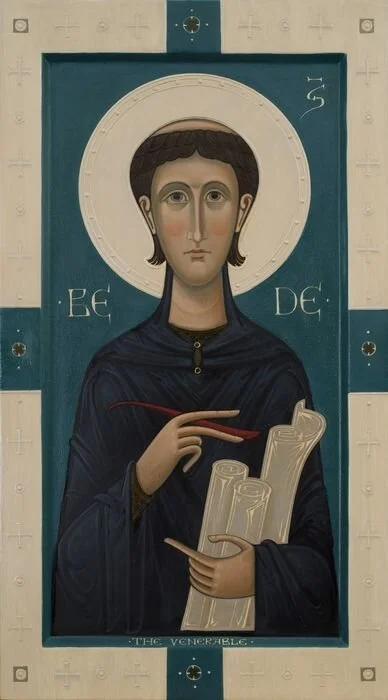
Bede on Shepherds

Bede, Homilies on the Gospels 1.7 in Arthur A. Just, ed., Luke, Ancient Christian Commentary on Scripture (Downers Grove, IL: InterVarsity Press, 2005), 42:

The shepherds did not keep silent about the hidden mysteries that they had come to know by divine influence. They told whomever they could. Spiritual shepherds in the church are appointed especially for this, that they may proclaim the mysteries of the Word of God and that they may show to their listeners that the marvels which they have learned in the Scriptures are to be marveled at.


afd69e553c895685e45309ba930a4295.jpg

How slick and weasel-Like is Self-Pride

“But O how slick and weasel-like is self-pride! Our learnedness creeps into our sermons with a clever quotation which adds nothing to God’s glory, but a bit to our own…

…But humility rests upon a holy blindedness, like the blindness of him who looks steadily into the sun. For wherever he turns his eyes on earth, there he sees only the sun.” (Thomas R. Kelly, A Testament of Devotion, 39.)

5 Questions for Preaching

Chip Scanlan suggests five questions for writing stories:

1. Why does it matter?
2. What's the point?
3. Why is this story being told?
4. What does it say about life, about the world, about the times we live in?
​5. What is my story really about? In one word.

Could we modify them for preaching?

1. Why does it matter?
2. What's the point?
3. Why is this story sermon being told preached?
4. What does it say about life, about the world, about the times we live in, about Christ?
​5. What is my story sermon really about? In one word.

Praying for Revival is Dangerous


“Many a church is praying for a revival that does not really desire a revival. They think they do, for to their minds a revival means an increase of membership, an increase of income, an increase of reputation among the churches, but if they knew what a real revival meant, what a searching of hearts on the part of professed Christians would be involved, what a radical transformation of individual, domestic and social life would be brought about, and many other things that would come to pass if the Spirit of God was poured out in reality and power; if all this were known, the real cry of the church would be:

’O God, keep us from having a revival.’”

R.A. Torrey, How to Pray, somewhere in chapter three (https://www.whatsaiththescripture.com/Voice/How.to.Pray.html#CHAPTER%20III)

Virtues in Affection

Walter Hilton in The Scale of Perfection (1.14):

There is many a man that has virtues, such as lowliness, patience, charity towards his fellow Christians and so on, only in his reason and will, but without any spiritual delight or love in them. Often he feels grudging, sad and bitter as he practices them, and nevertheless he does it, stirred only by reason and the fear of God. This man has virtues in his reason and will, but not love of them in affection. But when by the grace of Jesus and by spiritual and bodily exercise the reason is turned into light and the will into love, then he has virtues in affection, for he has so well gnawed the bitter bark of the nut that he has broken it and feeds upon the kernel.

The Glory of Corporate Worship

In Exodus 38, Moses describes the cost of constructing the Tabernacle. In addition to various animal skins and fine linens, the Tabernacle’s curtains, supports, furniture, and sacred instruments required “29 talents and 730 shekels” of gold and “100 talents and 1,775 shekels” of silver (Ex 38:24–25). If those measurements don’t make much sense to you, they didn’t to me either. But I did some math.

According to archaeological evidence, a talent—a unit measuring an object’s weight—was between 65 and 75 pounds, and a talent was equal to 3,000 shekels.[1] So the total weight of gold used in the Tabernacle’s construction was between 1,900.795 lbs (29x65 + .243x65, since 730 shekels = .243 talents) and 2,193.225 lbs (.243x75+29x75). That’s between 30,412.72 and 35,091.6 ounces. On February 3, 2019, 1 oz of gold is worth $1,317.93. Therefore, the gold required for constructing the Tabernacle was worth between $40,081,836.07 and $46,248,272.39.

I’m just a pastor, so you’ll have to forgive me if my math doesn’t check out and for leaving it to you to figure out the silver. My point stands. The Tabernacle might seem to us like a dusty tent, but it would have been glorious to behold. And it didn’t compare to the Temple, which Solomon constructed using the “100,000 talents of gold and 1,000,000 talents of silver, and bronze and iron beyond weight” (1 Ch 22:14) that David had saved up.

The opulence of these sacred gathering places puts the world’s greatest cathedrals to shame, not to mention the plain and undecorated rooms in which we Baptists worship. But that’s alright, our worship is glorious, not for its surroundings (gold that adorns walls, doors, pulpits, or pews), but for its object. Christians gather each week in unassuming buildings, high school cafeterias, and movie theaters to enter into the presence of God through Christ, the One who “tabernacled” among us and revealed the glory of the unseen God (Jn 1:14), and that’s the glory involved in corporate worship. The gold of the Tabernacle shined bright in the sun of ancient deserts, but it was as a shadow compared to the light and glory revealed in Christ.

___

1. Walter A. Elwell and Barry J. Beitzel, “Weights and Measures,” Baker Encyclopedia of the Bible (Grand Rapids, MI: Baker Book House, 1988), 2138.
The Basis for Spiritual Stability and Peace

How tranquilizing and stabilizing it is to us when we consider that we have a personal interest in all the eternal acts that passed between God the Father and the Lord Christ on our behalf even before man was created, as well as in all those acts that were transacted between the Father and the Son in and throughout the whole of His mediatorial work that He wrought and finished here below. It is this covenant salvation, in its full blessedness and efficacy, apprehended by faith, that alone can lift us out of ourselves and above our spiritual enemies, that can enable us to triumph over our present corruptions, sins, and miseries. It is wholly a subject for faith to be engaged with, for feelings can never provide the basis for spiritual stability and peace. Such can only be obtained by a consistent feeding upon objective truth, the Divine counsels of wisdom and grace made known in the Scriptures. — A.W. Pink, Effectual, Fervent Prayer (Grand Rapids: Baker, 1981), 50.

Our machines

 “We only do what humans can do, and our machines, however they may appear to enlarge our possibilities, are invariably infected with our limitations. Sometimes, in enlarging our possibilities, they narrow our limits and leave us more powerful but less content, less safe, and less free. The mechanical means by which we propose to escape the human condition only extend it; thinking to transcend our definition as fallen creatures, we have only colonized more and more territory east of Eden.”

Wendell Berry, “Two Economies,” in Home Economics  (San Francisco: North Point Press,  1987).

When I consider the short span of my life...

“When I consider the short span of my life absorbed into the preceding and subsequent eternity...I am terrified, and surprised to find myself here rather than there, for there is no reason why it should be here rather than there, why now rather than then. Who put me here? On whose orders and on whose decision have this place and this time been allotted to me?” - Blaise Pascal, Pensèes, 102. 


Astrology and the rejection of truth

From Julie Beck's article in The Atlantic"Why Are Millenials So Into Astrology?," —

"'I think it’s become generally less acceptable to just arbitrarily s**t on things as like "that’s not rational," or "that’s stupid because that’s not fact,"' says Nicole Leffel, a 28-year-old software engineer who lives in New York."

"Stevens’s story exemplifies a prevailing attitude among many of the people I talked to—that it doesn’t matter if astrology is real; it matters if it’s useful."


Source: https://www.theatlantic.com/health/archive...

Trust & Rural Communities

In his new book, “Globalization and Its Discontents Revisited: Anti-Globalization in the Era of Trump,” Stiglitz argues that economists missed something important about these towns: They have social capital. Trust is what you might call the “magic fairy dust” that helps economies thrive. When people trust each other, they work better and harder and they tend to live happier lives, as Harvard professor Robert Putnam's research has shown. Overall, trust has eroded substantially in the United States in recent years as fewer and fewer people have a bond with their neighbors, let alone the government, businesses or civic institutions. But trust still exists in many of these smaller towns where people talk to and watch out for each other. That can be harnessed to transform the town for the 21st century, Stiglitz says...

Source: https://www.washingtonpost.com/amphtml/new...